Cover Photo: Second Wave Ocean Images
Sixteen years ago, a change began to take shape in the Mexican Caribbean that did not originate from a single institution or a single project, but from a convergence between: scientists, divers, fishermen and civil organizations that agreed on the same idea—sharks were not a resource to be extracted without limits, but an essential piece of the marine balance that had to be understood, protected and valued.
That vision found its expression in Saving Our Sharks, an initiative that, over time, became a bridge between scientific knowledge and community action. Its story is also the story of a profound cultural transformation in the relationship between people and the ocean.
The origin of a new perspective (2010)
In 2010, Saving Our Sharks AC was formalized, bringing together biologists, divers, and conservationists with a clear objective: to change the narrative about sharks in the Mexican Caribbean.
This process was not insignificant. It involved federal and environmental institutions such as SAGARPA, CONAPESCA, SECTUR, CONANP and the Cozumel National Park, as well as to multiple dive centers in the region: Phantom Divers, Alberto's Scuba, Pepe Dive Center, UWE Underwater Expeditions, Phocea México, Dive Mike, Yucatek Diver, Pro dive, Buceo Xtabay, Dressel Divers, Solo Buceo, Scuba Libre, Scuba Maroma, Playa Scuba, Scuba 10, Pluto Dive, WetSet, Deep Down Media, Sand Dollar Sports, Scuba Maroma, México Blue Dream, Ecodiving Tours, DiveMex, Dive Zone, Bullsharks Diving Center, Dos Ojos Scuba, O2 México, Reef Marina, Playa Diving Center, Dive Life
The key to this stage was collaboration: for the first time, conservation ceased to be an isolated action and became a shared effort, with common rules, agreements, and objectives.
Science that becomes management (2013–2016)
The next major leap forward occurred when science began to be directly integrated into decision-making. In 2013, acoustic telemetry systems were implemented, along with the first bull shark tagging, allowing researchers to understand their routes, movement patterns, and behavior. This initiative was led by Dr. Mauricio Hoyos, one of the Foundation's advisors.
A year later, the Good Practices Manual for Bull Shark Diving was developed in collaboration with operators, experts, and authorities. This document not only regulated a growing tourist activity but also established a standard for responsible interaction with the species.
The process culminated in 2016 with the decree establishing the Mexican Caribbean Biosphere Reserve as a Protected Natural Area, where these community and scientific advances were incorporated into the official management framework. This confirmed that the model worked.
Consolidation of a model (2017–2019)
Between 2017 and 2019, the work was expanded with studies conducted in coordination with CONANP (National Commission of Natural Protected Areas) on breeding areas, population dynamics, and the regulation of scuba diving tourism. At the same time, training programs were strengthened, reaching hundreds of divers each season and reinforcing safe and responsible practices.
In 2019, a satellite tagging campaign for tiger sharks was carried out in conjunction with MOTE Marine Laboratory It expanded the scope of scientific knowledge about pelagic species, connecting the Mexican Caribbean with global research networks.
The expansion towards a transformation model (2021–2025)
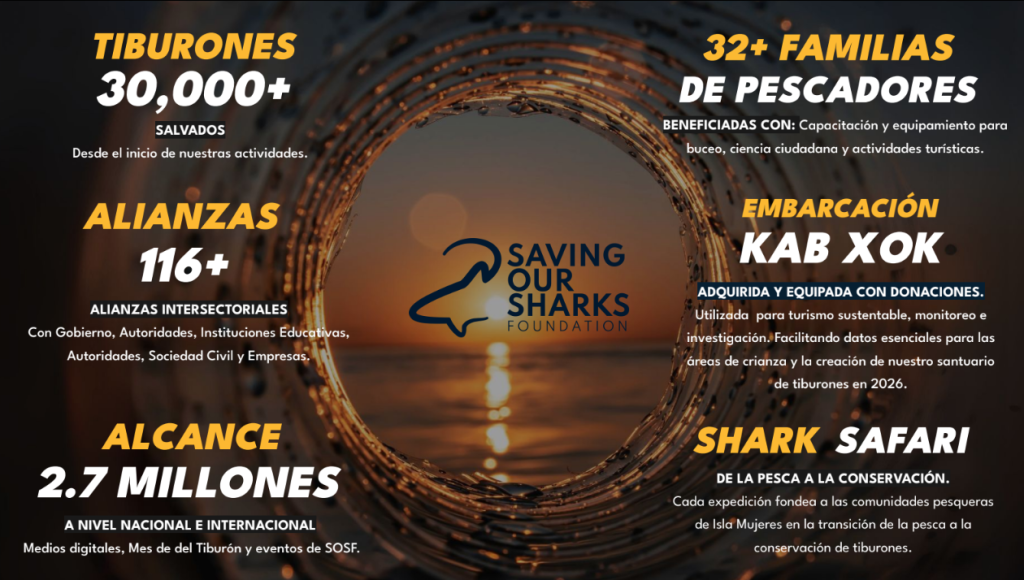
In 2021, the Saving Our Sharks Foundation was formally established with an international vision and the Isla Mujeres Shark Initiative. Its objective was clear: to transform the relationship with sharks from their extraction to their conservation, through the reconversion of the fishing sector.
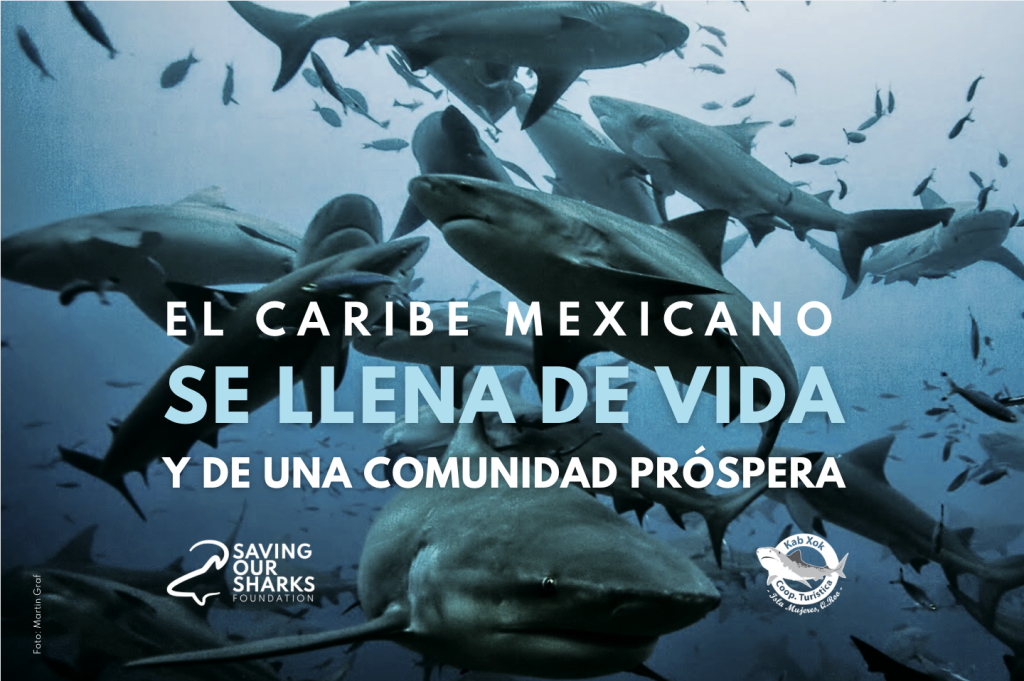
From this process emerged the Kab Xok Cooperative, made up of fishermen with generations of history at sea who decided to transition to sustainable tourism. They became "Masters of the Sea," protagonists of a new economy based on conservation.
In the following years, the project gained scientific and global recognition. In 2023, the first ultrasound study of bull sharks in the region was published, and a visit from Dr. Sylvia Earle reinforced its international relevance. Simultaneously, Shark Month was integrated into the state's environmental agenda, with more than 116 partnerships and dozens of educational and community activities.
A visible impact on the ocean (2025–2026)
Today, the results are measurable. The Isla Mujeres Shark Initiative has contributed to the protection of more than 30,000 sharks in just a few years, demonstrating that science and community can generate real impacts on the recovery of marine ecosystems.
In Playa del Carmen, bull shark sightings have doubled. In Cozumel, after decades, species such as hammerhead, tiger, and reef sharks have reappeared. In Isla Mujeres, the presence of sharks is becoming increasingly frequent, also strengthening specialized tourism.
This change has directly benefited dozens of local families, trained in tourism, diving and sustainable operation, generating new economic opportunities without depending on extraction.
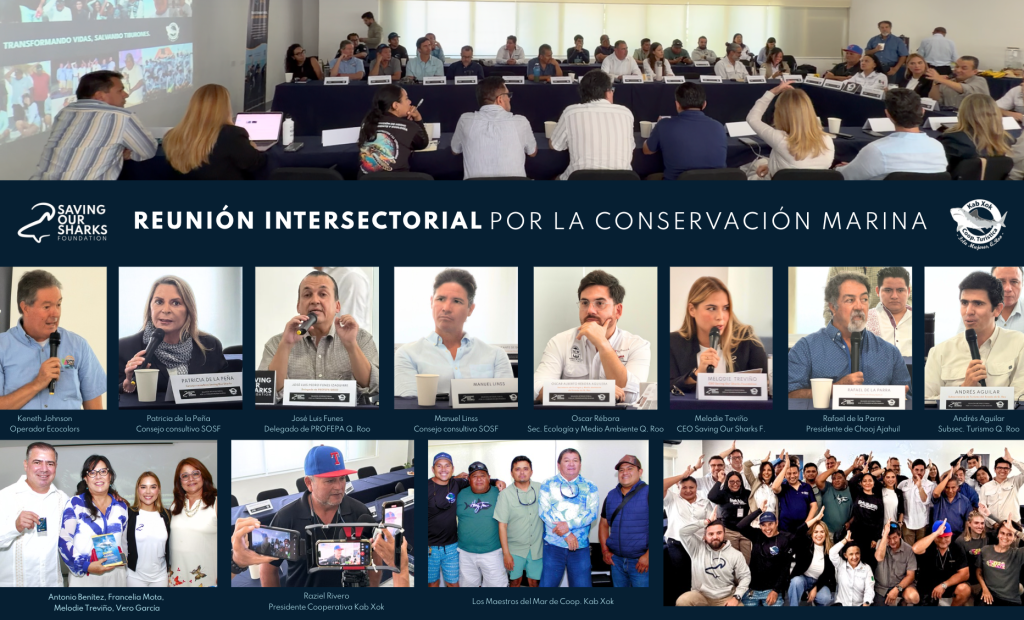
In 2026, the Foundation continues to evolve, solidifying its recognition and support as a key player in marine conservation. A clear example of this growth was the success of the Intersectoral Meeting for Marine Conservation, organized by Saving Our Sharks. This event brought together representatives from government, the tourism sector, education, and local communities to reaffirm their commitment to ocean protection. During the meeting, new strategies were explored to strengthen marine conservation and promote a sustainable development model based on collaboration, science, and the well-being of coastal communities, thus fostering a healthier and more prosperous ocean for everyone.
Sixteen years later, Saving Our Sharks is not just an organization, but a movement that has reshaped the relationship between people and the sea. A process that has shifted from fishing to conservation, from uncertainty to knowledge, and from extractive exploitation to a regenerative economy.
The Mexican Caribbean has not only seen a return of sharks: it has also rediscovered a new way of understanding their value. And with that, the certainty that the future of the ocean can be built together.