CITES 2025, Samarkand
The Oceanic Whitetip Shark, the Whale Shark, and Manta Rays receive maximum international protection under Appendix I of the Convention on International Trade in Endangered Species of Wild Fauna and Flora. (CITES), prohibiting its international trade for commercial purposes.
Ocean conservation requires science, commitment, and above all, international collaboration. In a global context where overexploitation and the illegal trade of marine species have endangered numerous populations, every advance in environmental policy represents a collective victory. The inclusion of the whale shark and the manta ray in Appendix I was approved by consensus during the 2025 CITES Conference of the Parties held in Samarkand, Uzbekistan.
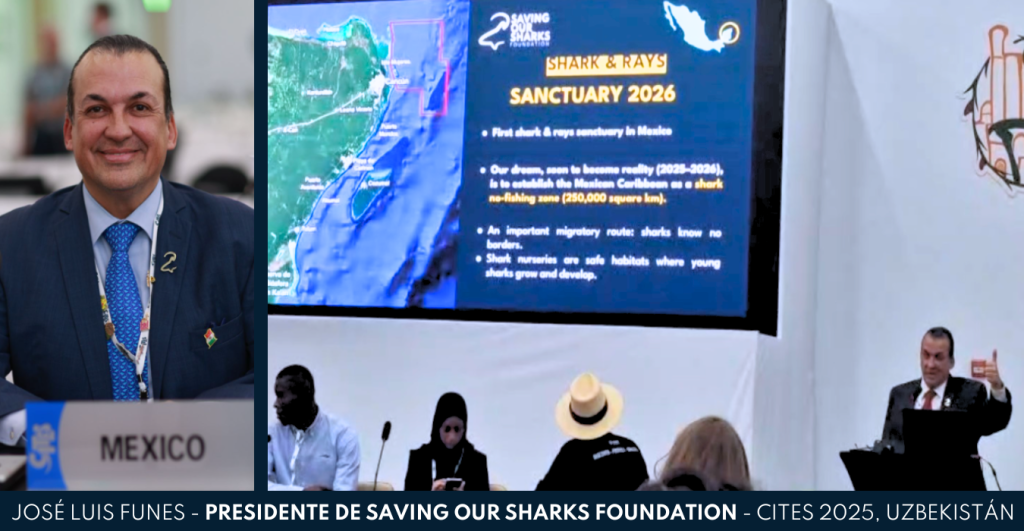
Saving Our Sharks Foundation was an active part of this historic process. With the participation of its president, José Luis Funes, in dialogue sessions, forums, and decision-making spaces at CITES 2025, where more than 3,300 delegates from 170 countries and international organizations gathered, this sustained work, in collaboration with governments, civil society organizations, and local communities, strengthened the arguments that now translate into greater protection for key ecosystem species.
Conservation is a collective effort, and every international decision brings the world closer to a future where sharks continue to fulfill their vital role in the planet's oceans.
For the Saving Our Sharks Foundation, these results confirm that consistent work in science, education, and international dialogue leads to real change. Protecting whale sharks, oceanic whitetip sharks, and manta rays not only benefits these iconic species but also strengthens the health of the oceans and the communities that depend on them.
The CITES Appendices
The Convention on International Trade in Endangered Species of Wild Fauna and Flora (CITES) It has three appendices These appendices classify species according to their level of risk and the degree of control needed over their international trade. They are key tools for global conservation.
Appendix I – The highest level of international protection.
- It includes the species most at risk of extinction.
- He International trade for commercial purposes is prohibited.
- Only very limited exceptions are allowed, such as scientific research, conservation programs or special situations, always under strict permits both from the exporting and importing countries.
Appendix II – Preventing species from reaching a critical state.
- It groups together species that They are not necessarily currently in danger of extinction, but that they could become so if your trade is not regulated.
- International trade It is allowed, but strictly controlled, through permits and scientific reports that ensure that the extraction It does not affect the survival of the species.
Appendix III – Strengthens conservation efforts at the national level with international support.
- It includes species that a country decides to protect within its territory and for which it requests international cooperation to control its trade.
- Trade is permitted, but it requires documentation that certifies its legal origin.